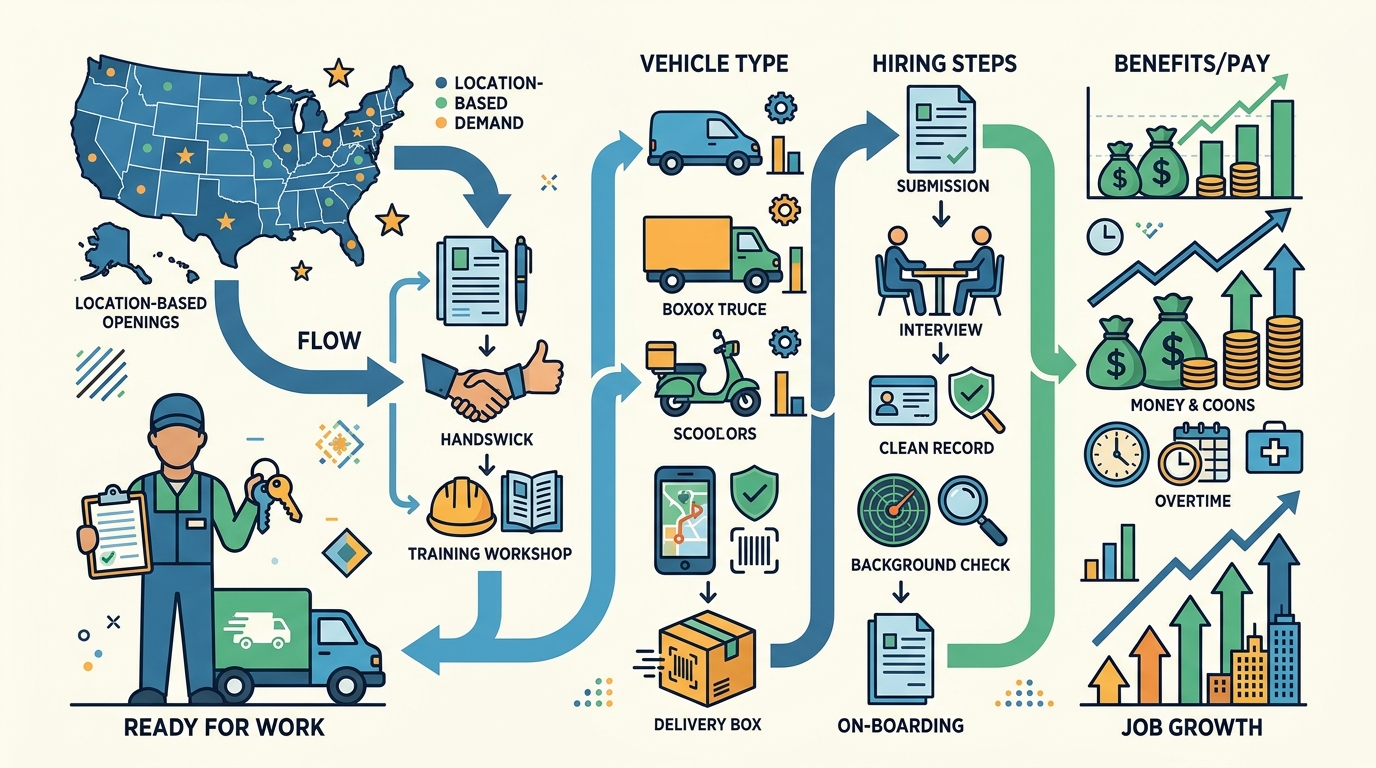
Delivery driving is one of the shorter on-ramps in the job market: the typical entry-level education is a high school diploma or equivalent, no prior experience in a related occupation is required, and training is short-term and on the job — usually less than a month (U.S. Bureau of Labor Statistics, 2025; CareerOneStop, undated). What employers screen hardest for is a valid driver's licence, a clean driving record, and the ability to handle a physically demanding day of loading, unloading and repeated stops (U.S. Bureau of Labor Statistics, 2025; CareerOneStop, undated).
Most delivery roles use light vehicles under 26,001 pounds, which do not require a commercial driver's licence (Federal Motor Carrier Safety Administration, undated). The steps below take you from checking your own record to following up on applications.
Your step-by-step path to a first role
Pull your own driving record from your state's motor vehicle agency this week. Employers expect a clean driving record (CareerOneStop, undated), so you need to see exactly what they will see. Request the official abstract, note any violations and when they drop off, and fix anything outstanding such as an unpaid ticket or a suspension hold.
Confirm your licence is current and that you can pass a state vision test. Holding a driver's licence requires passing your state's vision test (U.S. Bureau of Labor Statistics, 2025). If you need corrective lenses, get the prescription updated before a renewal appointment, not after a job offer.
Decide whether you need a CDL — most likely you do not. A commercial driver's licence is required for vehicles over 26,000 pounds, vehicles carrying 16 or more passengers, or placarded hazardous materials (O*NET OnLine, undated). If you are driving a van or box truck under 26,001 pounds hauling property, no CDL is required (Federal Motor Carrier Safety Administration, undated). Skip paid CDL training until you have decided you want heavy-vehicle work.
Search using the full range of job titles. The same work is posted as Delivery Driver, Route Driver, Package Delivery Driver, Package Car Driver, Light Truck Driver, Bulk Delivery Driver, Service Provider and Warehouse Driver (O*NET OnLine, undated). Searching only "delivery driver" hides a large share of the openings.
Match your application to the two different job types. Straight delivery work centres on verifying loads against shipping papers, inspecting the vehicle, reading routes and loading and unloading (O*NET OnLine, undated). Driver/sales work adds taking orders, collecting payment and stocking merchandise at the point of delivery (CareerOneStop, undated) — so lead with any retail, cash-handling or customer-facing experience there.
Write one page that proves reliability, not personality. Give years of licensed driving, vehicle types you have driven, any route or warehouse work, and evidence you can lift and move goods all day — the job is physically demanding (U.S. Bureau of Labor Statistics, 2025).
Apply in volume and in person where you can. Openings for delivery truck drivers and driver/sales workers are projected at about 152,700 each year on average over 2025–35 (U.S. Bureau of Labor Statistics, 2025), so turnover is constant. Local depots, food distributors and courier contractors often hire from walk-in enquiries.
Follow up within five business days. Call or email the hiring contact, restate your licence status and availability, and ask where your background and driving-record check stands. Keep a one-line log of every application so follow-ups do not overlap.
What to prepare before you apply
A valid driver's licence with your current address, plus a note of its expiry date so it does not lapse mid-hire.
A recent copy of your motor vehicle record ordered from your own state agency. Rules on who can request it and what it costs differ by state.
Proof of a high school diploma or equivalent, which is the typical entry-level education for this occupation (U.S. Bureau of Labor Statistics, 2025).
Two or three work references with current phone numbers — former supervisors are better than character references. Ask permission before listing them.
A short written availability statement: days, earliest start time, latest finish, and whether you can take weekend or holiday peak shifts.
A plain record of your driving history: vehicle types and sizes driven, approximate years, and any route, courier, warehouse or forklift experience.
Evidence of customer-facing or cash-handling work if you are targeting driver/sales roles, where counting cash, making change and persuading customers to try different products all matter (U.S. Bureau of Labor Statistics, 2025).
Where to look for openings
Your state workforce agency's job bank and American Job Centers, which list local openings and often run free résumé help.
National job boards, searched under each of the alternate titles above rather than one phrase.
Careers pages of local distribution centres, wholesalers and food distributors — drive past the industrial parks near you, note the company names on the gates, and check their sites directly.
Staffing and logistics temp agencies, which place drivers for seasonal peaks and sometimes convert placements into permanent routes.
Courier and last-mile contractor networks, where the delivery firm's brand is on the van but a smaller contractor is the employer doing the hiring.
Trucking and delivery trade associations, including state-level associations, which run their own job boards and member directories.
Restaurant, pharmacy, laundry and beverage route postings, which cover driver/sales work such as take-out delivery and commercial laundry pickup (CareerOneStop, undated).
Frequently asked questions
Do I need a CDL to be a delivery driver?
Usually not. A CDL is required for vehicles over 26,000 pounds, vehicles carrying 16 or more passengers, or placarded hazardous materials loads (O*NET OnLine, undated). A driver transporting property in a vehicle under 26,001 pounds is not required to hold one (Federal Motor Carrier Safety Administration, undated). Check the specific vehicle class in each posting, and check your state licensing agency for any state-level endorsements.
How long is training before I am driving a route alone?
No work experience in a related occupation is required, and training is short-term and on the job (U.S. Bureau of Labor Statistics, 2025) — typically less than one month (CareerOneStop, undated). The exact length varies by employer and by how complex the route and handheld systems are.
Will I be drug tested?
It depends on the vehicle and the employer. The Federal Motor Carrier Safety Administration's random drug and alcohol testing rules under Part 382 apply to drivers subject to CDL requirements; non-CDL drivers are not covered by them (summary of 49 CFR Part 382). Many employers still run their own pre-employment testing as a condition of hire, so ask during the interview.
What does the job pay?
Pay is usually hourly or route-based, and some driver/sales workers such as pizza delivery drivers also receive tips on top of an hourly wage (U.S. Bureau of Labor Statistics, 2021). Earnings vary widely — for light truck drivers in May 2025, the lowest 10 percent earned less than $30,800 and the highest 10 percent more than $80,310 (U.S. Bureau of Labor Statistics, May 2025). Check the Bureau of Labor Statistics Occupational Outlook Handbook and your state workforce agency for current local rates before accepting an offer.
Is the work physically hard?
Yes. The Bureau of Labor Statistics describes delivery truck driver and driver/sales work as physically demanding (2025), and core tasks include loading and unloading the truck or van as well as inspecting and maintaining vehicle equipment (O*NET OnLine, undated). Patience in heavy traffic is also listed as an important quality (U.S. Bureau of Labor Statistics, 2025).
 Aspirational Hub