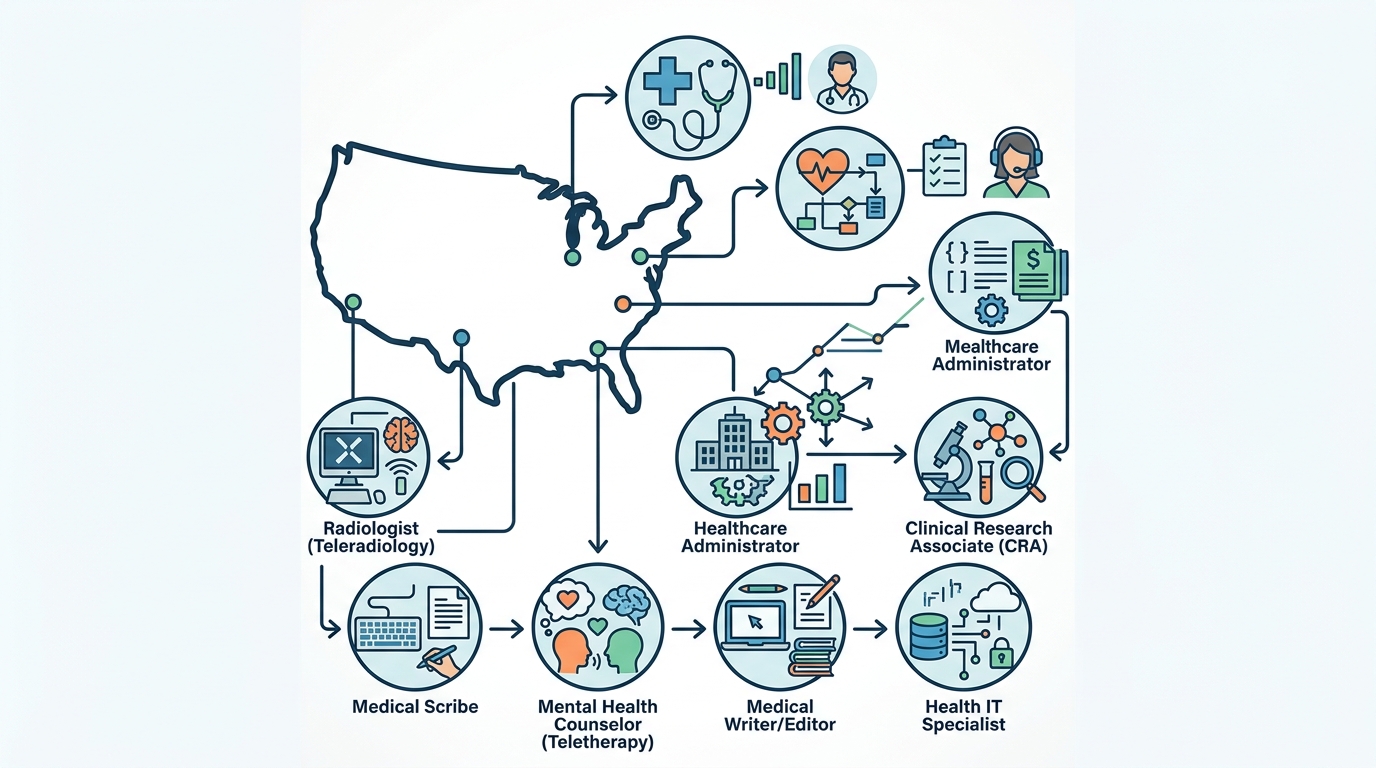
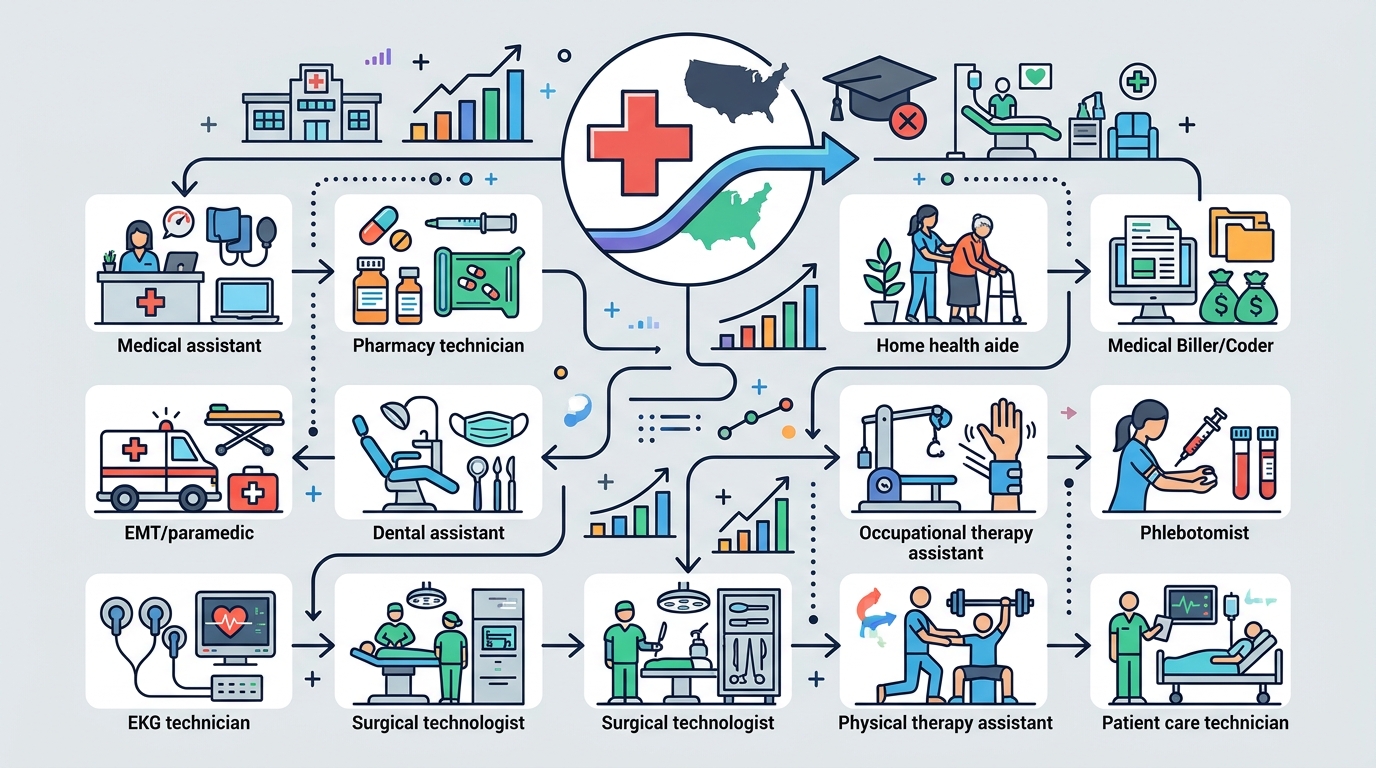
Plenty of healthcare roles take people with no clinical background: patient transport, environmental services, dietary aide, unit clerk, patient registration, sterile processing trainee, home care aide, medical scribe, pharmacy technician trainee and similar jobs. Most ask for a high school diploma or equivalent, a clean background check, current immunisation records and the willingness to work shifts — not a degree.
Some of the better-paid entry roles (nursing assistant, phlebotomy, EKG, pharmacy technician) do need a short certificate or state registration first, and those rules differ by state. The plan below helps you sort which group a job falls into before you spend money on training.
Your step-by-step path to a first role
Pick three target roles, not fifteen. Sort the options by how much direct patient contact you want. Hands-on care (nursing assistant, home health aide, patient transporter), behind-the-scenes (sterile processing, environmental services, dietary, medical records) and desk-facing (patient registration, unit clerk, scheduler, scribe) are three different jobs. Write down your top three.
Check the rules for those exact titles in your state. Nursing assistant, home health aide, phlebotomist and pharmacy technician are regulated in some states and not others. Look at your state health department, nurse aide registry or board of pharmacy website, then cross-check against ten current job postings in your city to see what local employers actually list as required.
Clear the baseline everyone asks for. Locate your high school diploma or GED, a government photo ID, your immunisation record (including TB screening, which most hospitals require), and be ready to consent to a criminal background check and drug screen. Start these now — records requests are the slowest part.
Get a CPR/Basic Life Support card. Many support roles ask for it and almost no clinical role will take you without it. Book a hands-on class through a community college, local fire department, hospital education department or recognised training provider.
Take a short credential only if step 2 said you need one. Where training is required, community colleges, adult education centres, workforce development boards and some employers themselves run programmes measured in weeks. Ask any programme how many of its recent graduates were placed locally and whether it includes the state exam fee.
Write a one-page resume in healthcare language. Translate what you have already done: retail becomes customer service under pressure, warehouse becomes safe lifting and inventory accuracy, caregiving for a relative becomes personal care, mobility assistance and record-keeping. Put availability, shift flexibility and certifications at the top.
Apply directly on health system career portals, in volume. Large employers post internally first. Create accounts, set alerts for your three titles, and apply to nights, weekends, per diem and float roles — those have the least competition and the fastest hiring.
Follow up and keep moving. Send a short thank-you email within 24 hours of any interview, ask what the next step and timeline are, and keep applying while you wait. If you get hired anywhere in the building, ask about tuition assistance and internal transfer rules in your first month.
What to prepare before you apply
Have these ready as files on your phone and computer so you can respond the same day a recruiter asks:
Proof of education — high school diploma, GED certificate or transcript, plus any certificate of completion from a training programme.
Government photo ID and your documentation for employment eligibility verification, in whatever form your situation requires.
Immunisation and health records — childhood vaccines, influenza, TB screening results and anything else your target employers list. Requirements vary by employer and by state.
A current CPR or Basic Life Support card from a hands-on course, with the expiry date visible.
A one-page resume and a short cover note you can adapt per posting, naming the exact job title and your available shifts.
Two or three references who have agreed in advance — a former supervisor, a teacher or instructor, and someone who can speak to your reliability. Collect current phone numbers and emails.
A written list of your availability and constraints (nights, weekends, transport, childcare). Recruiters ask early, and a clear answer moves your application forward.
Where to look for openings
Health system and hospital career portals. The biggest employers in most US metro areas post entry-level support roles continuously on their own sites, often before anywhere else. Set up alerts on each one within driving distance.
General job boards with filters. Search by the specific title ("patient transporter", "sterile processing technician I", "dietary aide"), not "healthcare", and sort by date.
Healthcare staffing and per diem agencies. Many place support and aide staff into hospitals, clinics and long-term care facilities, and they are often willing to take candidates with no prior healthcare work.
Long-term care, assisted living and home care agencies. These hire the highest volume of entry-level caregivers and frequently train on the job where state rules allow.
Your state and local workforce development board or American Job Center. They list openings, run subsidised short training and know which local employers are hiring now.
Community college career services and allied health departments, which post employer requests and apprenticeship or earn-while-you-learn openings.
Professional and trade associations for the specific role — nursing assistants, sterile processing, health information and pharmacy technicians all have national bodies with job boards and state chapters.
For pay, check current figures for your state and metro area on the Bureau of Labor Statistics Occupational Outlook Handbook and Occupational Employment and Wage Statistics pages, then compare against live postings — rates move and differ sharply between settings.
Frequently asked questions
Do I really need a certificate to start?
It depends entirely on the job title and your state. Support roles such as transport, environmental services, dietary, registration, unit clerk and many sterile processing trainee positions commonly train new hires on the job. Nursing assistant, home health aide, phlebotomy and pharmacy technician roles are regulated in some states and require approved training, an exam or registry listing. Confirm on your state agency's website before paying for anything.
How long does the hiring process usually take?
For entry-level hospital roles, expect several weeks between applying and starting. A phone screen and one or two interviews are typical, followed by a conditional offer, then background check, drug screen and occupational health clearance — that last stage is often what takes longest. Smaller home care and long-term care employers frequently move faster.
What will an employer check before I start?
Most run a criminal background check and a drug screen, verify your education, and send you to occupational health for immunisation review and TB screening. Some roles also involve a physical capacity check because of lifting. The specific requirements differ by employer, by state and by care setting; ask the recruiter what the post-offer steps are so nothing surprises you.
How do I interview well with no healthcare experience?
Expect behavioural questions about reliability, confidentiality, handling difficult people and following instructions exactly. Prepare three short stories from any job, volunteering or family caregiving that show you showed up, stayed calm and asked when unsure. Say clearly that you understand patient privacy matters and that you will escalate rather than guess.
Which of these roles leads somewhere?
Support roles inside a hospital put you close to internal postings and, at many employers, tuition assistance. Nursing assistant work is a common step toward nursing; sterile processing and pharmacy technician roles have their own certification ladders; registration and medical records lead into health information and revenue cycle work. Ask about internal transfer eligibility — some employers require six to twelve months in your first role.
 Aspirational Hub