Aspirational Hub

Career Change at 50: A Step-by-Step Plan

Most people over 50 switch fields by repackaging what they already do rather than starting over — here is how to test the idea before you spend money.

Table of contents
Featured image for "Career Change at 50: A Step-by-Step Plan"

A career change at 50 usually takes six to eighteen months from first research to first offer, and it goes best when the new role reuses most of the judgement, relationships and process knowledge you already have. The sequence matters more than the enthusiasm: talk to people doing the job, confirm the entry requirement, then buy the training — in that order.

This guide gives you a readiness check, a map of what transfers, five role types with their entry requirements, a month-by-month plan, and an honest look at the money.

Is it right for you? (checklist)

Answer each question out loud, yes or no. Three or more honest noes does not mean the change is wrong — it means you are not ready to spend money on it yet.

1. Can you name the job title, not just the field? "Something in healthcare" is not a target. "Medical coding specialist in an outpatient clinic" is. Until you have a title, you cannot check the entry requirement, and you will buy training nobody asked for.

2. Have you spoken to three people who do the job now? Not three people who teach it or sell training for it. Three people doing it, ideally one who also changed into it later in their career. They will tell you the parts of the job the course description leaves out.

3. Does the new role reuse at least half of what you already do? Scheduling, budgets, documentation, de-escalation, compliance, supervising people — these travel. If the new role reuses almost nothing, you are not changing careers at 50, you are starting one, and the timeline and pay dip both get bigger.

4. Can you absorb twelve months of lower or interrupted income? Run the number before you enjoy the idea. If the answer is no, the realistic route is a sideways move inside your current employer, or retraining part-time while you keep working.

5. Are you comfortable being new, and reporting to someone younger? You will be corrected by a 29-year-old team lead. People who cannot do this quietly tend to stall in the first six months, and it shows in probation reviews.

6. Do you know what the entry requirement actually is, and who issues it? A certificate, a state licence, a portfolio, or nothing but a willing employer — these are very different purchases. Licensing varies by state in the US and by country elsewhere; the issuing body's own website is the only place worth reading first.

7. Is the pull toward the new work stronger than the push away from your current manager? A bad boss is a reason to change jobs. It is an expensive reason to change careers. Separate the two before you enrol in anything.

Where this goes wrong The common failure is buying the training first. Someone completes a certificate, then discovers local employers want two years of hands-on experience, or that the licence they need is issued by a state board with its own exam and background check. The order that works is: title, people, requirement, funding, training. Reverse it and you have paid for a line on your résumé that nobody was asking for.


What transfers (table)

Read this as a prompt for your own inventory, not a finished list. Open a spreadsheet, list every recurring task from the last three years of your work, and write beside each one where it would land in your target role. The specifics — a system name, a volume, a regulation — are what makes it credible in an interview.

Skill from your current roleWhere it lands in the new one
Running a team roster, budget or shift planProject coordination: resource planning, status reporting, keeping a schedule honest when two things slip at once
Handling escalated complaints and angry customersClaims handling, patient access, client services, dispute resolution — documented de-escalation is a hiring criterion, not a soft skill
Writing SOPs and training new startersOnboarding, instructional design, quality and compliance roles that live on written procedure
Reconciling invoices, chasing payment, checking vendor billingBookkeeping, accounts payable/receivable, medical billing — the habit of making two numbers agree is the whole job
Reading contracts, regulations or safety rules and applying themCompliance, underwriting, inspection, auditing, benefits administration
Diagnosing why equipment or a process stopped workingIT support, field service, facilities, operations — structured troubleshooting transfers across the hardware
Holding long-term relationships with suppliers or clientsAccount management, procurement, recruitment, partnerships
Supervising people and handling performance conversationsAny coordinator or team lead role, and the reason employers hire career changers over graduates for them

Two things transfer that are hard to put in a table: knowing when a plan is about to fail, and being unbothered by conflict. Name them with an example rather than as adjectives.

Roles to aim for (table)

These are role types that regularly take career changers because the entry requirement is a credential or a licence rather than a four-year degree. Retraining times assume part-time study alongside work unless stated, and vary with the provider's schedule and how much of the material you already know.

RoleEntry requirementTypical retraining time
Project coordinatorDocumented project experience, often plus the CAPM from the Project Management Institute; some employers ask for the PMP once you have the hours2-6 months part-time
IT support / service desk analystCompTIA A+ (two exams) or an employer's own entry programme, plus a home lab or helpdesk portfolio3-9 months part-time
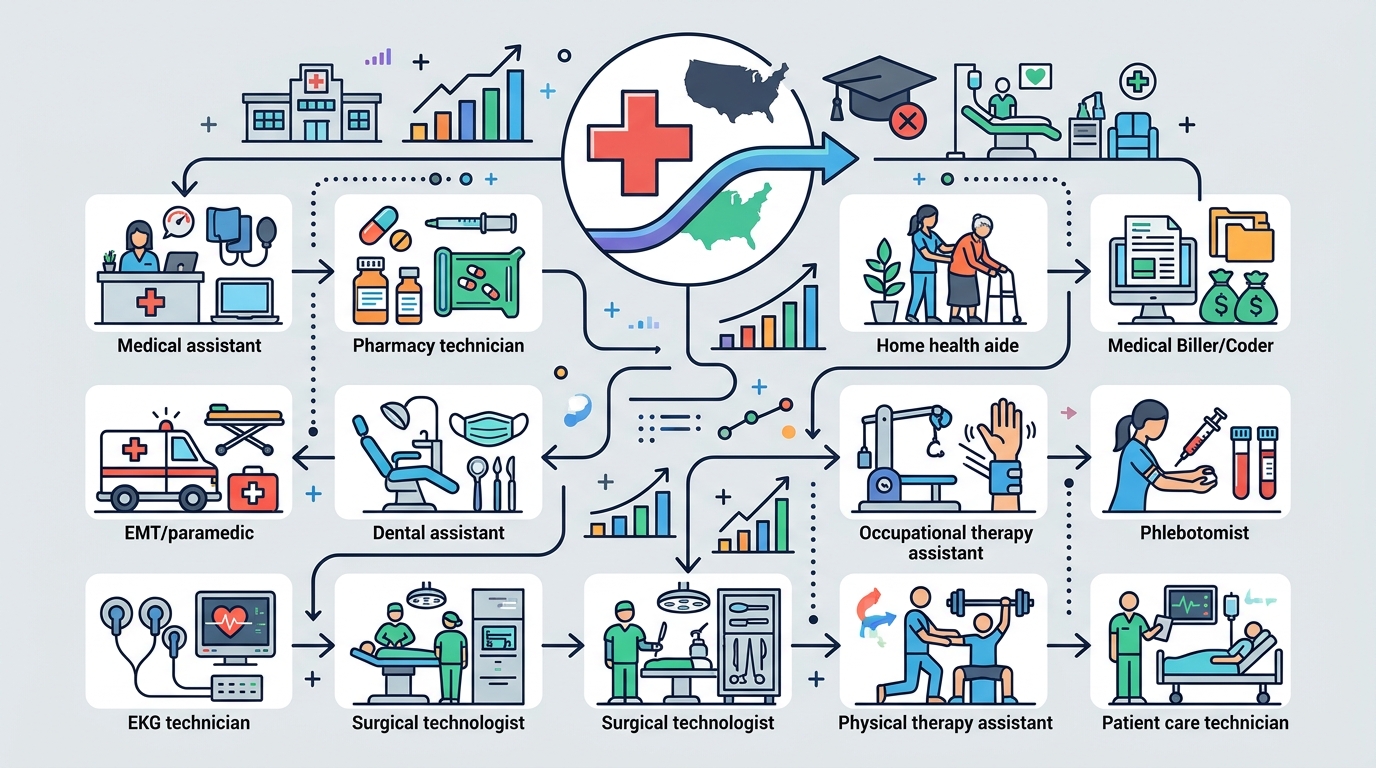
Medical coding or billing specialistAnatomy and terminology coursework plus a credential such as the CPC (AAPC) or CCA (AHIMA); many employers also want an apprentice-level placement first6-12 months
Bookkeeper or payroll administratorA bookkeeping or payroll certificate plus demonstrable accounting-software skill; registration requirements for paid preparers differ by jurisdiction3-9 months
Commercial driver (Class A CDL)Entry-level driver training from an FMCSA-registered provider, the state CDL knowledge and skills tests, and a DOT medical certificate4-10 weeks full-time

Three caveats before you pick one.

  • Licensing is state-level for many US roles — CDLs, insurance adjusting, nursing, real estate, childcare. The requirement in your state may differ from the one described in a national course advert. Check your state board or licensing department directly. Outside the US, check the national regulator or awarding body.
  • Demand is local. A credential that opens doors in a metro with large hospital systems may not do the same in a rural county. Look at live job postings within your commuting radius and count how many actually name the credential.
  • For outlook, duties and typical education by occupation, the BLS Occupational Outlook Handbook is the standard free reference in the US; your state workforce agency publishes regional data alongside it.

The plan (timeline)

Twelve months is a realistic frame for a credential-based change. Licensed or clinical routes run longer; an internal move can run shorter. Each step below starts with something you can do this week.

Months 0-3: test the idea before you spend

  1. Build a skills inventory in a spreadsheet: one row per recurring task, with the system you used, the volume, and who you did it for.
  2. Shortlist three job titles, not three industries, and save ten live postings for each.
  3. Highlight the words that repeat across those postings — a credential, a software package, a licence. That repeated list is your actual entry requirement.
  4. Pull the BLS Occupational Outlook Handbook entry for each title and read the "How to Become One" section.
  5. Book 30-minute informational calls with six to eight people in those roles — start with former colleagues, your alumni network, and people two steps removed from you on LinkedIn.
  6. Ask your HR department for the written tuition assistance or professional development policy. Many employers fund credentials that are adjacent to your current job; the policy document tells you what counts.
  7. Call your local American Job Center and ask whether your target occupation is on the state's in-demand list and whether you qualify for training funds. Eligibility rules are set at the state level.
  8. Choose one target title and write down the single sentence that connects your last job to it.

Script: asking for an informational call

Hi [name] — I'm a [current role] at [employer] and I'm researching a move into [target title] over the next year. I'm not asking about openings. Could I take 25 minutes to ask what the work is actually like day to day and what you'd do differently if you were entering now? Happy to work around your schedule.

Months 3-6: build the proof

  1. Enrol in the specific credential the postings named — and check the provider is recognised by the body that issues it before you pay.
  2. Register for the first exam with a date on the calendar. An open-ended study plan at 50, around a full-time job, drifts.
  3. Volunteer for a [project] at your current employer that produces evidence in the new area — run the vendor migration, own the compliance audit, take the budget reconciliation nobody wants.
  4. Rewrite your résumé around the target title: two pages, the last 10-15 years in detail, earlier roles compressed to one line each, and the skills inventory language from month one.
  5. Update your LinkedIn headline to name the target role alongside what you do now, and turn on the setting that tells recruiters you are open.
  6. Join the professional association or local chapter for the field and attend two meetings in person. For coordinator and trades roles especially, this is where informal referrals start.
  7. Ask two of the people from your informational calls to review your résumé against what their hiring manager looks for.

Months 6-12: convert it

  1. Sit and pass the exam, then add the credential to your résumé, LinkedIn and email signature with the issuing body named in full.
  2. Apply to 10-15 carefully targeted roles rather than 100 generic ones; tailor the first six lines of each résumé to the posting's repeated words.
  3. Ask each of your network contacts to flag you internally before you apply — a referred application is a different queue.
  4. Prepare three stories in situation-action-result form, each ending in a number you can defend.
  5. Rehearse the career-change question out loud until it takes 30 seconds, not three minutes.
  6. Take a contract, part-time or temp-to-hire role if it is offered. At this stage, recent experience in the new field is worth more than the title on the contract.
  7. Review at month nine: if you have had no first-round interviews from 15 targeted applications, the problem is the target or the résumé, not your age. Go back to two of your contacts and ask them to tell you which.

The money side (list)

Cost and income are the two places career changes at 50 fail quietly. Work through these before you enrol in anything.

What retraining costs

Prices vary enormously by provider, state and format, so treat these as tiers and get the actual figure from the provider's published tuition page or cost sheet.

  • Free to low cost: your employer's tuition assistance scheme, state workforce training funds administered through American Job Centers, union training funds, library and community programmes. Exhaust these first — most people never ask.
  • Low to mid: a single certification exam plus self-study materials. Exam fees are published by the issuing body (for example, CompTIA, PMI, AAPC) and are usually per-attempt, so budget for a retake.
  • Mid: a community college certificate, priced per credit hour, with the rate published by the college and usually lower for in-district residents.
  • Higher: private bootcamps, licensed-trade schools and associate degrees, which can reach five figures. Before paying, ask the provider for their completion and placement figures in writing and ask three graduates whether the figures matched their experience.
  • Hidden costs people forget: exam retakes, background checks, fingerprinting, medical certificates, licence application and renewal fees, tools or equipment, insurance, travel to a testing centre, and lost overtime while studying.

The pay dip

  • Expect to enter the new field at or near the bottom of its range, even with 25 years of working life behind you. Your experience shortens how long you stay there; it rarely removes the step down.
  • Two moves make the dip larger: changing field and sector at once, and changing city at the same time. If you can hold one variable steady, do.
  • Check the range before you commit, not after. The BLS Occupational Outlook Handbook gives national figures by occupation, and your state workforce agency publishes regional detail. Live job postings in your area that disclose a range are the most current signal you have, and pay transparency rules differ by state.
  • Ask in the informational calls what someone typically earns in their first year versus their third. People will usually describe the shape of the curve even if they will not name their own number.
  • Factor in benefits, not just pay: employer retirement match, health coverage, and how a gap in contributions affects what you were planning to retire on.

The buffer

  • Hold six to twelve months of essential expenses in cash before you leave a job for retraining. Nearer twelve if the route involves a licence, a waiting list, or a clinical placement you do not control the timing of.
  • Keep retraining costs out of that buffer — budget them separately, or the first unexpected expense eats your runway.
  • Avoid funding a career change by cashing out retirement accounts or taking on high-interest debt. Talk to a fee-only financial adviser or a nonprofit credit counsellor before you touch either; rules on early withdrawal and tax treatment are specific and worth checking against your own situation.
  • Model a part-time or phased route as the default rather than the fallback. Retraining while employed is slower and more tiring, but it removes the deadline that makes people accept the first offer they get.

The downside to price in

Some of this money may not come back. You might pass the exam and find local employers want hands-on hours you do not have, or complete a certificate just as the one large employer in your area freezes hiring. The way to limit the loss is to keep the first commitment small — one exam, one short certificate, one internal project — and only spend the large sum once a person doing the job has told you it is the thing that gets you hired.

Frequently asked questions

Will employers hold my age against me?

Some will, and pretending otherwise is not useful. What you can control is the signal you send. Keep your résumé to two pages with the last 10-15 years in detail and earlier roles as single lines, drop graduation dates, and show current tools by name — an old email client or an outdated system in your skills list does more damage than your date of birth. In interviews, answer questions about the future tense in the future tense: how long you plan to stay, what you want to learn, who you want to learn it from. Age discrimination in employment is covered by federal rules in the US with additional protections that vary by state; the EEOC publishes what the federal rules cover if you want to read them. Separately, hiring managers often prefer career changers for coordinator, compliance and client-facing roles precisely because they have handled difficult people and messy processes before.

Do I need to go back for a degree?

Usually not, and it is the most expensive assumption in this process. The entry requirement is whatever the job postings in your area repeat — often a certification, a licence, a software skill, or a portfolio. A degree becomes necessary where a regulator or a profession requires it, such as nursing, teaching in most states, social work or accounting at the CPA level. Check the issuing body or state board directly rather than a course provider's summary of it, and ask whether prior learning, military experience or an existing degree in another subject shortens the requirement. If a degree genuinely is required, ask the institution about credit for prior learning and part-time evening routes before you assume full-time study.

How do I explain the change without sounding like I failed?

Use three beats and keep it under 30 seconds: what you did, what pulled you toward this work, and what you have already done about it. For example: "I spent [number] years running [function] at [employer]. The part I kept gravitating to was [specific task], so I earned [credential] this year and ran [project] to prove it out. That's why I'm applying here." The evidence beat is what stops it sounding like escape. Never open with what was wrong at the old job, even if it was true — interviewers hear that as a risk to them. If you were laid off, say so plainly in one clause and move straight to what you did next.

Is it worth retraining if I plan to retire in 12-15 years?

Treat it as a payback question rather than an age question. Add up the total cost — tuition, exams, licence fees, and the income you give up during the transition — and estimate how long the new role takes to earn that back, then judge whether the remaining working years clear it comfortably. Short-payback routes are credential-based roles that reuse your existing skills; long-payback routes are ones requiring years of study and a long apprenticeship at the bottom. Non-financial reasons are legitimate too — work you can physically keep doing into your sixties, or a role with better hours — but put a number on the cost so you are choosing with your eyes open.

Should I tell my current employer I'm retraining?

It depends on whether the credential is adjacent to your current job. If it is, saying so usually helps: it can unlock tuition assistance, and it gives you a reason to ask for the internal project that becomes your evidence. Ask HR for the written policy first so you know what is funded and whether there is a clawback clause if you leave within a set period. If the credential clearly points away from your employer's work and your relationship with your manager is tense, keep it to yourself until you have something to announce. Either way, the internal move is worth testing before the external one — changing role inside an organisation that already trusts you is the shortest version of this whole plan.